
Bugonia Would Rather You Feel Insane Than Feel Nothing
Yorgos Lanthimos's alien-abduction thriller wins its bleakest joke by proving the paranoid guy correct, then making that victory feel like nothing at all.
By MIGUEL MATEO | OCTOBER 27, 2025
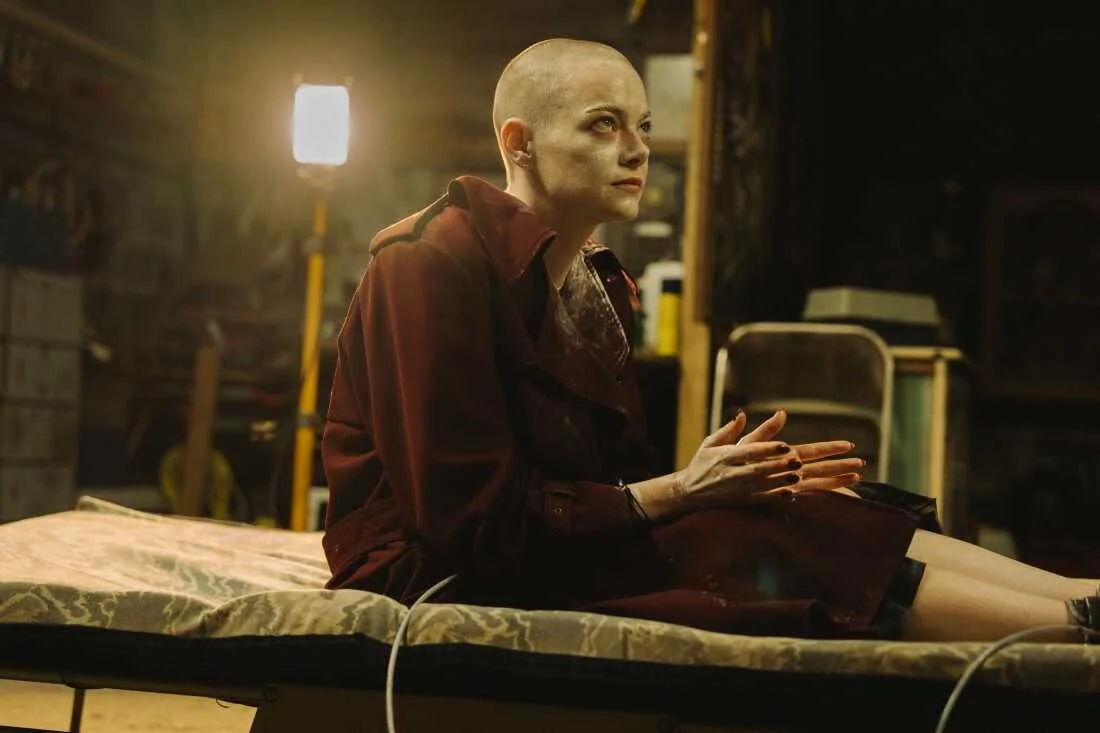
For the first hour, Bugonia plays the easy game. Teddy has kidnapped a pharmaceutical CEO in his basement, shaved her head because he believes Andromedans communicate through hair, and started building a case for her extraterrestrial origin that any sane viewer is meant to find pathetic. Lanthimos lets the audience feel superior to him for exactly as long as it takes to yank that comfort away. The film's real subject is not whether Teddy is crazy. It's what happens to a story once you stop being allowed to dismiss the person telling it.
The clearest evidence of what the film is actually doing sits in a scene that has nothing to do with aliens at all. When the local sheriff, played by Stavros Halkias, shows up at Teddy's house, the film lets the visit curdle without ever stating outright what happened between them years earlier. What lands is the request for a slice of cake sitting out on the counter, delivered with the same casualness he'd use to ask about the weather. The horror isn't dramatized. It's served alongside dessert. That's the register the whole film operates in, and it's a harder trick to sustain over two hours than it looks.
None of this works without the two actors carrying it, and Plemons in particular deserves more than a passing nod. He remains one of the most underrated actors working, someone who disappears so completely into a role that it's easy to take for granted how hard the disappearing act actually is. Teddy could have collapsed into caricature, a twitchy conspiracy theorist played for cheap laughs, but Plemons finds the person underneath the paranoia instead, and the film lets us understand the psyche driving him rather than just gawking at his behavior. Stone matches him beat for beat, and at this point her filmography has to be talked about as one of the great runs any actor is currently putting together, each film somehow raising the bar the last one set.
The ending resists the tidy read. Teddy turns out to be right that the aliens are real, but the reveal complicates rather than rewards him: they're not conquerors, they're what's left of an earlier version of humanity that mutated and tried to intervene. There's no cosmic villain waiting to be unmasked. The mess was always ours. That's a harder needle to thread than a simple vindication of the conspiracy theorist, and it's why the film earns its final stretch instead of coasting on a twist. Anyone walking out annoyed that the paranoid guy got proven correct hasn't sat with what he was actually correct about.
Jerskin Fendrix's score deserves more credit than "unsettling," the word that gets reached for too easily. What makes it work is that it was composed blind, without the script, on instructions as bare as "write something for a basement" or "write something for a spaceship." That disconnection is audible, and it's the right disconnection. The music doesn't know the story it's illustrating any better than Teddy understands the world he's decoding, and the effect is a soundtrack that feels alien to its own film in a way no amount of deliberate dissonance could fake.
The last images, empty streets, a ship moving low across open water, the visible aftermath of something that already happened, are as strong as anything else Lanthimos put on screen this year, and they work precisely because the film has spent two hours training you not to look away from things that are supposed to be too small or too strange to matter.
Calling this an ecological warning wrapped in genre clothing undersells it. Bugonia isn't interested in delivering a message so much as in making the audience sit inside a paranoid person's logic long enough to feel what it costs to be right about the wrong thing. That's a harder, stranger film than the premise promises, and it holds up.
Rating: ★★★★ out of ★★★★★