
Frankenstein Finds a Familiar Monster: Us, and Whoever We've Decided Not to See as Human
A gothic monster movie that turns out to be about who gets to be called human at all.
By MIGUEL MATEO | OCTOBER 26, 2025
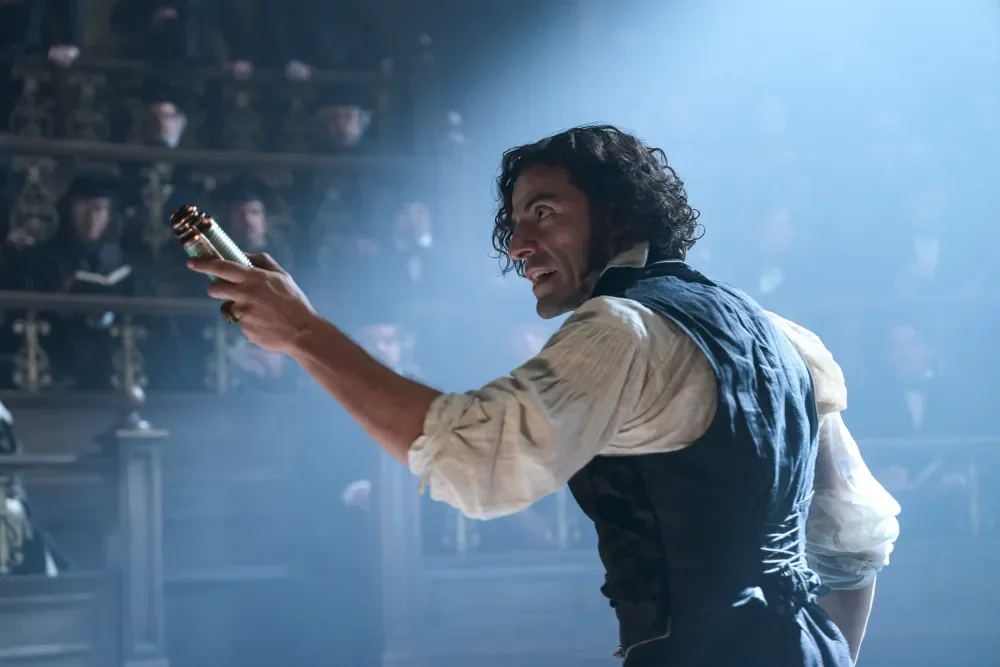
Guillermo del Toro has spent his career arguing that monsters are usually the most human thing in the room. The amphibian man in The Shape of Water wanted tenderness. The fascists in Pan's Labyrinth wore human faces and were the only real monsters on screen. Frankenstein is the culmination of that argument rather than a new entry in it, and del Toro seems to know it. This isn't a director trying on Mary Shelley for size. It's a filmmaker who has been building toward this specific story his entire career, and it shows in how unhurried and unguarded the film is willing to be.
The scene that makes the case better than any amount of description could is the one where the Creature, having found something like a home in secret alongside a blind man who can't see him well enough to be afraid, fights off a pack of wolves to protect him. He gets hunted for it afterward. That's the whole film in miniature. The one act of pure, unrewarded generosity he's allowed is answered with a torch and a chase. Jacob Elordi plays the moment before the violence, the instinct to protect rather than the instinct to strike, and that's what makes what follows land as tragedy instead of just plot mechanics. It's a performance built on stillness and on how much feeling Elordi can put into a face buried under prosthetics. The tragedy isn't that the Creature becomes a monster. It's how long he resists becoming one, and how little it takes from the people around him to push him there.
That resistance is where the film's real subject lives. Del Toro isn't subtle about drawing a line between the Creature's exile and the way marginalized people get cast as threats simply for existing in public. The parallels are there for race, for sexuality, and, most pointedly right now, for how immigrants get talked about as an invading force rather than as people. None of this required updating the text or winking at the camera. Shelley's novel was already asking who counts as a person and who doesn't. Del Toro just refuses to let the audience look away from the fact that the question is still live.
Some early response to the film has dismissed it as too literal, pointing to a scene where a character says the quiet part out loud and tells Victor plainly that he's the real monster. That criticism assumes subtlety is always the more sophisticated choice. It isn't. Del Toro has never been an ironic filmmaker, and Frankenstein earns its directness because it has spent two and a half hours building the emotional case for it. By the time the line lands, it isn't a thesis statement. It's a diagnosis the film has already proven.
Oscar Isaac's Victor is the film's other half, and he's smart about not competing with Elordi for sympathy. His Victor is brilliant, vain, and incapable of loving anything he can't control, which makes him the actual antagonist of the story even when he's not on screen. Mia Goth and Christoph Waltz orbit around that central relationship without ever pulling focus from it, which is its own kind of discipline in a film this visually dense.
See it in a theater if there's any way to. Del Toro shoots for scale, texture, and the kind of production design that rewards a big screen and a dark room, and the film's emotional rhythms are built around that scale too. This is a movie that wants to overwhelm you a little before it breaks your heart. It's rare that a director gets to make the exact film he's been circling for a decade, and rarer still that the result feels this urgent rather than reverent.
Rating: ★★★★1/2 out of ★★★★★