
Hamnet: Jessie Buckley's Aching Masterclass in Grief
Chloé Zhao's adaptation of Maggie O'Farrell's novel finds the tragedy behind Shakespeare's most famous absence, and builds it entirely around the woman left holding it.
By MIGUEL MATEO | NOVEMBER 16, 2025
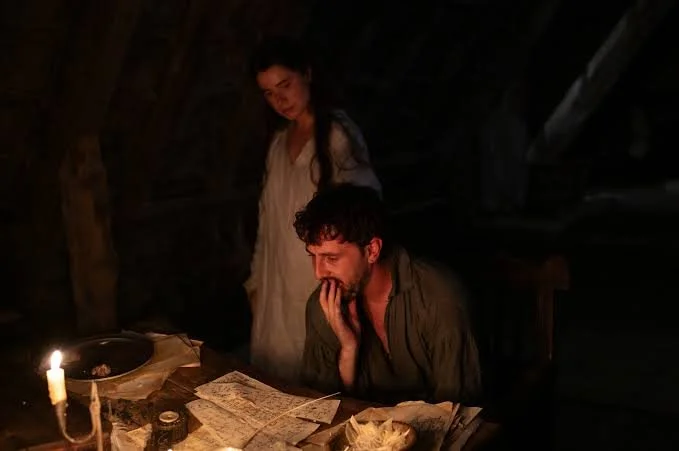
History barely records that Shakespeare had a son named Hamnet, who died at eleven, four years before his father wrote a play called Hamlet. That gap between a real death and its faint echo in the work is where Hamnet chooses to live. The film is not interested in solving the mystery of what Shakespeare felt. It is interested in what happens to the person standing next to him while he goes quiet, and how a household absorbs a loss that history itself declined to record.
That decision shapes everything about the film's rhythm. Agnes and William's marriage is built in the opening stretch through small physical rituals, foraging together, a courtship that reads as instinctive rather than romantic in the conventional sense, so that when Hamnet dies partway through, the film has already taught the audience how this family touches, listens, and stays silent. Grief here is not delivered as a single wrenching scene so much as a slow redistribution of weight, with Agnes carrying hers visibly and William carrying his by disappearing into work, into London, into the version of himself that can turn pain into language for a living. The cruelty of the film's structure is that it makes Agnes wait, for most of its runtime, to learn that her husband was grieving too. She has simply been alone in a house that assumed his silence meant absence rather than depth.
Jessie Buckley carries that weight. Her performance reorganizes the entire film around her, and its structure rests on her ability to hold two very different emotional registers a full runtime apart. Hamnet's death arrives at the midpoint, and Buckley breaks the audience in that instant, playing the rupture as something almost too sudden and too total for Agnes to metabolize in real time. She then spends the final fifteen minutes doing the harder work of reassembling that same audience, moment by careful moment, until the ending lands as release rather than resolution. Few actresses working now could locate both halves of that with this much control.
Paul Mescal continues building the case that he is one of the finest actors of his generation, and one of the most emotionally open. William could easily read as a man who simply leaves, but Mescal keeps him legible even at his most absent, playing someone who processes loss by fleeing into his work rather than his family without letting that retreat curdle into coldness. It is a performance built on withholding, which makes the moments he finally lets go land harder.
Jacobi Jupe, as Hamnet, gives one of the strongest child performances in recent memory, grounding the back half of the film's loss in a specific, warm, fully realized boy rather than a symbol. And Zhao's direction, which has always favored the textures of hands, fields, and the space between two bodies in a room over conventional exposition, has been quietly building toward the closing stretch the whole time.
That closing stretch is where the film risks the most, and where it earns the most. A husband and wife watching their dead son restaged as a character onstage, the wife realizing mid-performance that her husband has been grieving as deeply as she has, is the kind of scene that could tip into wet, overreaching sentimentality in lesser hands, whether the director's or the actors'. Zhao, Buckley, and Mescal never let it. The scene works because it is staged as recognition rather than catharsis for its own sake. Agnes finally gets to say goodbye to Hamnet through watching him rendered onstage, but the more devastating turn belongs to William, who has spent the entire film unable to face his son's death directly and can only cope with it once removed, through his own work. And even then, what undoes him is not the play itself but watching his wife watch it, seeing her grief and understanding meet his in real time. It is a scene built on two people finally reading each other correctly, and it earns every second of the fifteen minutes it takes.
Rating: ★★★★1/2 out of ★★★★★