
No Other Choice: A Marriage Buckling Under the Weight of Capitalism's Cruelty
In a year defined by layoffs dressed up as progress, Park Chan-wook turns one man's unemployment into a murder plot and a marriage into the scene of the crime.
By MIGUEL MATEO | DECEMBER 3, 2025
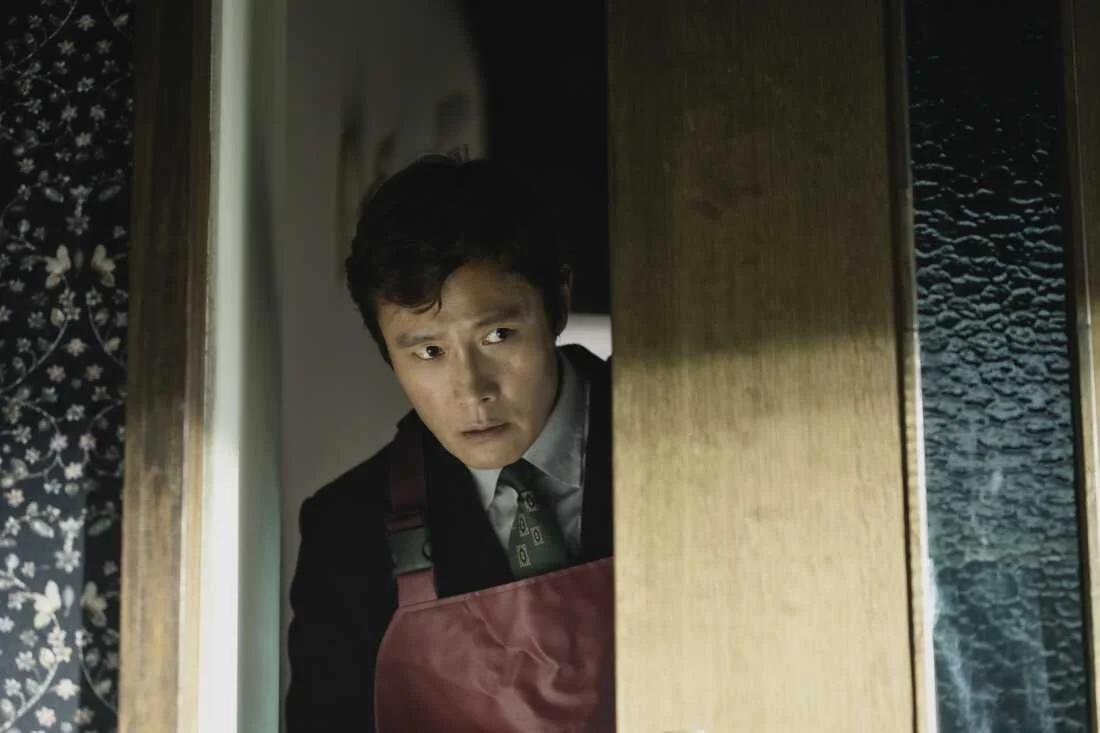
When Man-su loses the executive job he held for twenty-five years at Solar Paper, the culprit is not incompetence but an American buyout that trades him for automation and artificial intelligence. No Other Choice opens on him gathering his wife Miri (Son Ye-jin), his stepson Si-one, his daughter Ri-one, and their two dogs for what he calls a one-minute hug in the garden of the home he loves, and it is exactly the kind of tenderness the film needs banked before it starts stripping it away. Adapted from Donald Westlake's novel The Ax, the film understands that its premise, a man murdering his way into a job, only works if the audience never stops liking him even as he stops being likable.
Lee Byung-hun carries that contradiction across two increasingly harrowing hours. His Man-su is proud without being arrogant, a former Pulp Man of the Year who genuinely believed the paper industry would keep him for life, and Lee plays the humiliation of the job hunt, interview after interview, each one shaving away a little more dignity, with a physical exactness that makes the character's eventual turn to violence feel less like a twist than an inevitability.
But the film's sharpest instincts are reserved for Miri, and Son Ye-jin's performance is doing just as much dramatic work as Lee Byung-hun's, even though her character spends much of the film seeming to stand outside the plot. When the police first arrive at the house to question Man-su, Son Ye-jin plays the moment almost entirely through her face, a flicker of doubt breaking through the composure of a woman who has spent months holding her family together and refusing to ask her husband hard questions. That doubt hardens into certainty once she digs up the body herself, and the horror on her face in that scene is not theatrical, it is the look of someone whose worst assumption about her marriage has just been confirmed by dirt on her hands. The phone call that follows, her voice trying to stay level while she processes what she now knows about the man she married, carries the film's most quietly devastating scene, more damaging in its restraint than anything Man-su does with a shovel.
And yet Miri's final move is not to turn him in. She protects him, and later she reshapes the story for their son, choosing the version of events that keeps her family intact over the one that is true. It's a quieter, more painful kind of complicity than her husband's, and Son Ye-jin plays the decision as neither forgiveness nor naivety but the recognition that protecting the people you love can mean becoming someone you don't recognize.
The ensemble around them is just as alive. Lee Sung-min plays Bummo, the first rival Man-su targets, as a man whose confidence has curdled into paralysis since his own layoff, funny and pitiable in equal measure, while Yeom Hye-ran, as his wife Ara, turns what could have been a nagging-spouse punchline into someone with her own appetites and grievances the plot never fully tames. Cha Seung-won's Sijo, a former paper man now moonlighting at a shoe store, makes the film's cruelest turn land hardest precisely because he is so decent, so nakedly grateful for the interview Man-su offers him under false pretenses. Even Park Hee-soon, as the Moon Paper manager whose casual condescension sets the plot in motion, registers as a fully drawn person rather than an obstacle. It is rare for a film this plotted to make every face in it worth remembering, and Park manages it without once slowing down.
The film does not let corporate power off easily either. The absorption of Solar Paper by an American firm chasing automation, and the interchangeable rivals Man-su fixates on eliminating, are drawn with the same darkly comic precision, an entire industry rendered as a machine that discards loyalty the moment a spreadsheet permits it. Park spent two decades wanting to make this film, and the patience shows in how confidently it treats the layoff not as backstory but as an ongoing violence the family never stops absorbing.
What keeps No Other Choice from curdling into pure cynicism is Park's control of tone, the way a scene can pivot from absurd to genuinely upsetting without warning. This is a director working at the height of his craft, orchestrating chaos with the same precision he has brought to a career full of morally compromised protagonists, and here that compromise feels urgently of the moment rather than confined to genre.
With the Academy's best picture race still taking shape, No Other Choice deserves to be part of the conversation, and not as a courtesy nod to a great director's overdue reckoning. It is a film that knows exactly what it is angry about, and it makes that anger, and the human cost underneath it, impossible to look away from.
Rating: ★★★★★ out of ★★★★★