
The Secret Agent: Wagner Moura Turns Silence Into a Weapon
In Kleber Mendonça Filho's Cannes-winning thriller, Wagner Moura delivers the most deserving international performance of the year, and Brazil delivers a second consecutive masterpiece.
By MIGUEL MATEO | DECEMBER 11, 2025
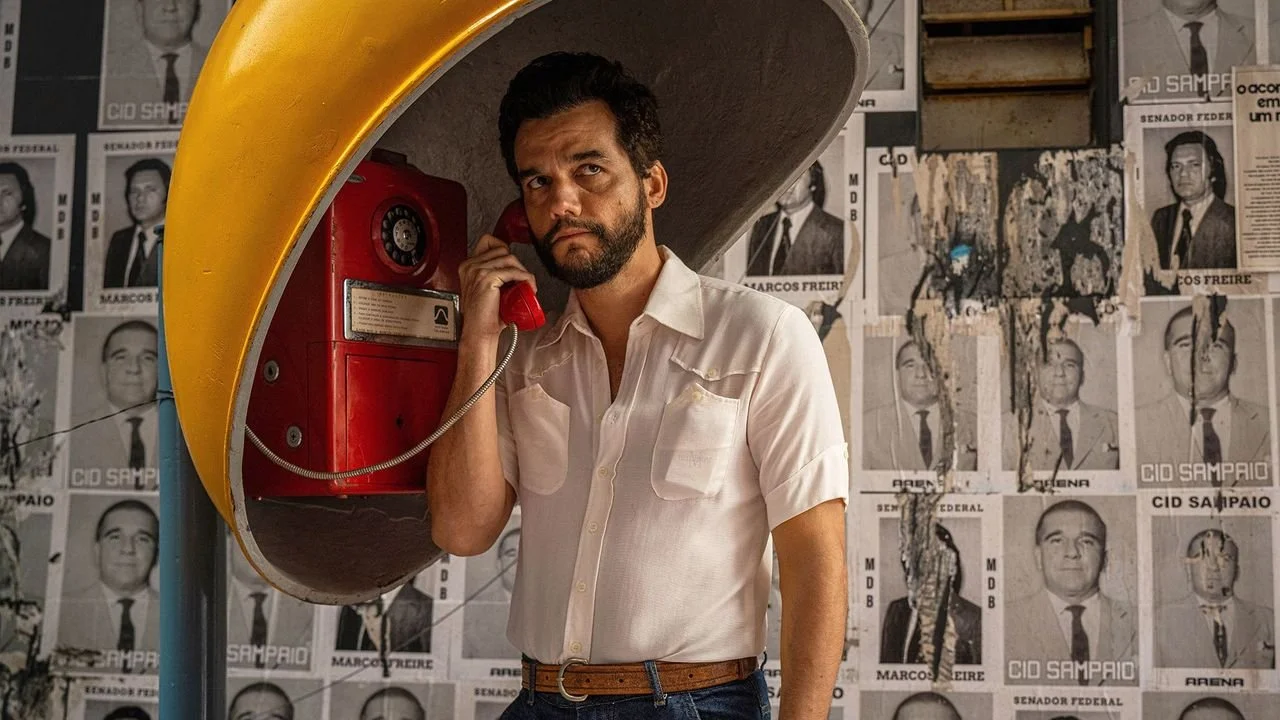
Kleber Mendonça Filho has a way of making history feel like it's breathing down your neck, and in The Secret Agent, Brazil's second consecutive Oscar submission to mine the 1970s for political urgency, he's found his most quietly devastating vehicle yet: Wagner Moura. This is a film that trusts stillness, that lets dread accumulate in doorways and phone booths rather than in shootouts, and it is anchored by a performance so controlled, so internally lit, that it reframes what a political thriller lead can look like.
Moura plays Marcelo, a former researcher whose real name is Armando, who flees São Paulo for his hometown of Recife during Brazil's military dictatorship, taking on the alias to reunite with his young son and dodge the hitmen a vendetta-driven executive has put on his trail. What could easily have been a paranoid-thriller sprint through checkpoints and safe houses instead unfolds as something closer to a tone poem about exhaustion. Marcelo is a man who has already used up his adrenaline; what's left is vigilance, and Moura plays vigilance like a second skin. Watch how he enters a room, how his eyes catalog exits before his mouth manages a pleasantry. It's a performance built on subtraction, on everything he refuses to let his face do, and that restraint makes the rare moments he cracks, a flicker of tenderness with his son, a private unraveling when the weight becomes too much, land like body blows. There's nothing sentimental in it. He never asks for your sympathy; he simply lets you watch a man metabolize terror in real time, and the vulnerability sneaks up on you precisely because he's fighting it so hard.
It's the kind of performance that recalls what Fernanda Torres did last year in I'm Still Here, another Brazilian awards contender excavating the same dictatorship-era wound from a different angle. Torres deserved that Best Actress Oscar and didn't get it; the Academy's international-film branch has a long, frustrating habit of nominating foreign-language performances and then declining to actually reward them in the acting categories. But this year, with international cinema dominating the conversation in a way it hasn't in years, feels like the moment for that pattern to break. Moura, an actor Americans mostly know from Narcos, playing a very different kind of controlled intensity here, has earned a seat at that table, and Best Actor is exactly where he belongs.
He is not carrying the film alone, though the movie is careful never to let you forget that resistance, and repression, were collective. The ensemble around him does extraordinary work building out the texture of a society learning to whisper. Tânia Maria, as Dona Sebastiana, the anarcho-communist elder who runs the refuge sheltering Marcelo and his fellow dissidents, lights up every scene she's in with a warmth that feels earned rather than performed, a maternal steel that suggests decades of quiet resistance behind her. Maria Fernanda Cândido brings a different register as Elza, the resistance leader whose scenes with Moura crackle with the tension of two people speaking in code even when they're being direct. And Gabriel Leone, as one of the hitmen hired to track Marcelo down, gives the film's menace a human face rather than a cartoon one, a killer who is himself just another man trying to survive a corrupt system. Every supporting player, from the network of allies who move Marcelo through safe houses to the informants and bureaucrats who represent the regime's quieter, more bureaucratic cruelty, feels lived-in rather than functional. The film understands that dictatorship isn't sustained by monsters alone but by ordinary people choosing, day after day, not to look too closely at what they're enabling.
And then there's Recife itself, or rather, Recife circa 1977, resurrected with a tactile, almost obsessive specificity. The production and costume design don't just dress the set; they seem to have excavated an entire sensory world, the mustard and rust palette of interiors, the particular grain of analog surveillance technology, the way sunlight falls differently through hand-me-down curtains than it does through anything shot today. Mendonça Filho has always been a filmmaker of place (Recife is practically a character across his filmography), and here the city becomes a kind of pressure chamber, humid, sun-bleached, simultaneously gorgeous and suffocating. Shot largely on location, the film leans into long lenses and unhurried compositions that make the period feel observed rather than reconstructed, like found footage rather than a costume drama. You don't feel the seams of a production design department at work; you feel transported, which is exactly the effect a film about historical memory needs to achieve.
What ties all of this together, the ensemble's quiet moral complexity, the immersive period reconstruction, is Moura's performance functioning as the film's nervous system. He is the audience's conduit into an atmosphere of institutional menace that never announces itself with violence so much as with silence, with the things people no longer say out loud. The Secret Agent is a film about the cost of vigilance, about what a body does to survive when the threat is invisible and everywhere, and Wagner Moura embodies that cost so fully, so without vanity, that it's hard to imagine a more deserving Best Actor contender this year. Brazil has sent the Academy a masterpiece two years running. It would be a shame if the Academy needed a third to finally listen.
Rating: ★★★★1/2 out of ★★★★★