
One Battle After Another Turns a Movement's Unfinished Business Into an All-Timer
Paul Thomas Anderson's tenth feature turns a father's rescue mission into a reckoning with a movement's afterlife, carried by an ensemble that never stops finding new registers to work in.
By MIGUEL MATEO | SEPTEMBER 29, 2025
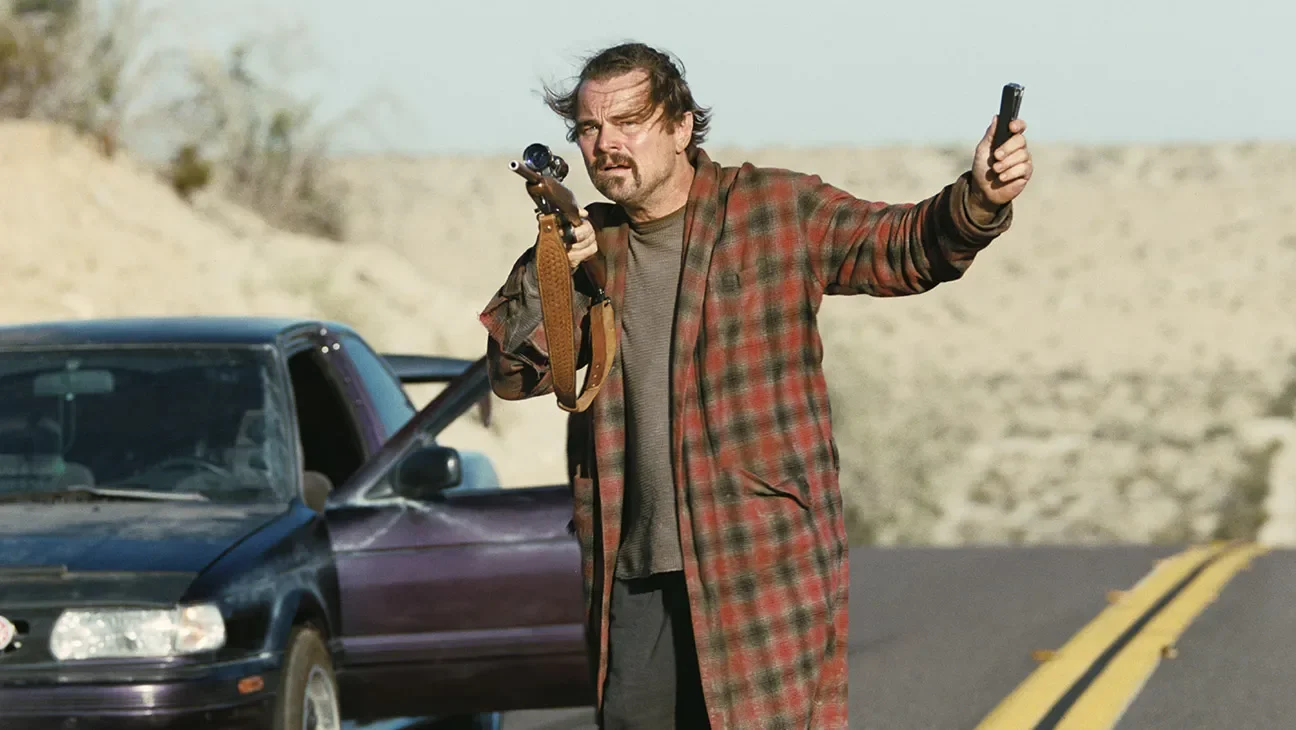
Paul Thomas Anderson's tenth feature never settles into a single genre because it does not need to. It opens as a militant romance, hardens into a manhunt, and closes as a father-daughter thriller staged across the undulating hills of Borrego Springs, and the film's confidence in moving between those modes is what makes it feel less like a survey of American unrest than a lived-in record of it.
The film's politics reward a second and third viewing more than a first. On an initial pass it can look like a settling of scores, a movie mostly interested in landing hits on the right. What comes into focus with more attention is something closer to a personal reckoning with what it felt like to believe change was coming and then watch that belief curdle, a shape that tracks less with any specific act of political violence than with the swing from the outsized hope of the Obama years into the exhaustion of everything that followed. Bob reads as close to a self-portrait for Anderson as anything in his filmography, down to the interracial marriage at the center of the story. The film's second half makes the exhaustion literal. The nuns who shelter Willa stand in for an institutional left gone quiet and inward, and the drop off in urgency between Perfidia's generation and Bob's own tired vigilance says more about the movement's afterlife than any of its speeches do.
Leonardo DiCaprio gives a hilarious yet warm performance as Bob Ferguson, a former explosives man for the revolutionary cell French 75 who has spent sixteen years dulling himself with weed and paranoia in the fictional town of Baktan Cross. The role could easily have played as a punchline, a stoner dad stumbling through a rescue, but DiCaprio finds real tenderness underneath the fumbling, particularly in the stretch where Bob cannot remember the coded password that would reconnect him with his old network and is reduced to phoning half-remembered contacts in a panic. It is DiCaprio at his most relaxed in years, willing to look foolish and scared at once, and the performance earns the film's insistence that Bob's incompetence is itself a form of love.
Teyana Taylor, as Bob's partner Perfidia Beverly Hills, occupies only the film's first stretch, but she leaves with all the oxygen in the room. Her Perfidia is magnetic and reckless in equal measure, a woman who mistakes velocity for purpose, and Taylor plays that contradiction without asking for sympathy she has not earned. She proves herself a star in a role built almost entirely on exit. Chase Infiniti, making her screen debut as the grown Willa Ferguson, has the harder job of carrying the film's back half opposite veterans, and she does it by refusing to perform strength for the camera. Her Willa is watchful, quick, and never quite trusting of the adults around her, which makes her transformation into the hero of the film's centerpiece chase feel earned rather than engineered. Infiniti is someone to watch.
The quiet MVP of the ensemble is Regina Hall. Her Deandra, a veteran member of French 75 who resurfaces years later to get Willa to safety, is given none of the film's showier beats, and Hall plays her with a stillness that could be mistaken for reticence if it were not so clearly a choice. Where Perfidia became myth, the figure the movement tells stories about, Deandra is the one who stayed, who kept doing the actual work long after the romance of the fight had drained out of it, and who shows up when it matters with none of the fanfare. Hall lets that history sit in her face rather than her dialogue. It is a performance about the sustaining work inside any movement, the organizing and caretaking and simple refusal to leave, labor that in this story and in the history it draws from tends to fall to Black women without ever becoming the part of the story anyone remembers to tell. Hall carries that weight without a single moment that reads as demonstrative. She anchors the film precisely because she refuses to compete with it.
Benicio del Toro supplies the levity the film needs as Sensei Sergio St. Carlos, Willa's martial arts instructor turned reluctant smuggler, playing every absurd request with the calm of a man who has simply decided panic is inefficient. Sean Penn, as the white supremacist colonel Steven J. Lockjaw, is at his peak, coiled and pathetic and borderline camp in the best possible way, a performance that flirts with parody without ever losing its menace. Their best work converges in the film's climactic car chase, staged along a stretch of rolling desert road nicknamed the Texas Dip, where Willa, Lockjaw's hired killer, and Bob crest and vanish over the same blind hills in pursuit of each other. Shot on VistaVision by cinematographer Michael Bauman and cut with real spatial clarity, the sequence turns geography itself into suspense, since none of the three drivers can see what waits on the other side of the next rise. Jonny Greenwood's score ticks and clatters underneath it like a countdown, and the effect is one of the most purely thrilling passages Anderson has ever directed.
Calling it the film of its year is a real claim, but the case for it rests on how precisely it reads as an expression of a wider mood rather than a period piece about the eighties left. It plays like a message aimed at an audience that has been told for years that voting once and walking away counts as the work, when the film's own ending argues the opposite, that nothing gets finished in one generation and the fight has to be handed off and picked up again the way Willa and Bob keep cresting the same blind hills, unable to see what's coming and unable to stop moving anyway.
What holds all of this together is Anderson's refusal to flatten his characters into position papers. The film is furious about what happened to the movement its characters gave their youth to, but it is more interested in what that fury costs a family than in scoring points. By the end, Bob is left with nothing but his daughter, walking beside her instead of ahead of her, and Deandra is left with the quiet knowledge that she outlasted the people the movement chose to remember. That is the film's real ending, not a battle won or lost but two people who kept going long after the cause stopped feeling like one. One Battle After Another is an all-timer, a film that trusts its actors to carry its politics and never once forgets what all that carrying costs.
Rating: ★★★★★ out of ★★★★★