
Weapons Finds Its Monster in Plain Sight
Zach Cregger's ensemble horror is a high-wire act of tone that somehow never falls, and it has Amy Madigan to thank for sticking the landing.
By MIGUEL MATEO | AUGUST 8, 2025
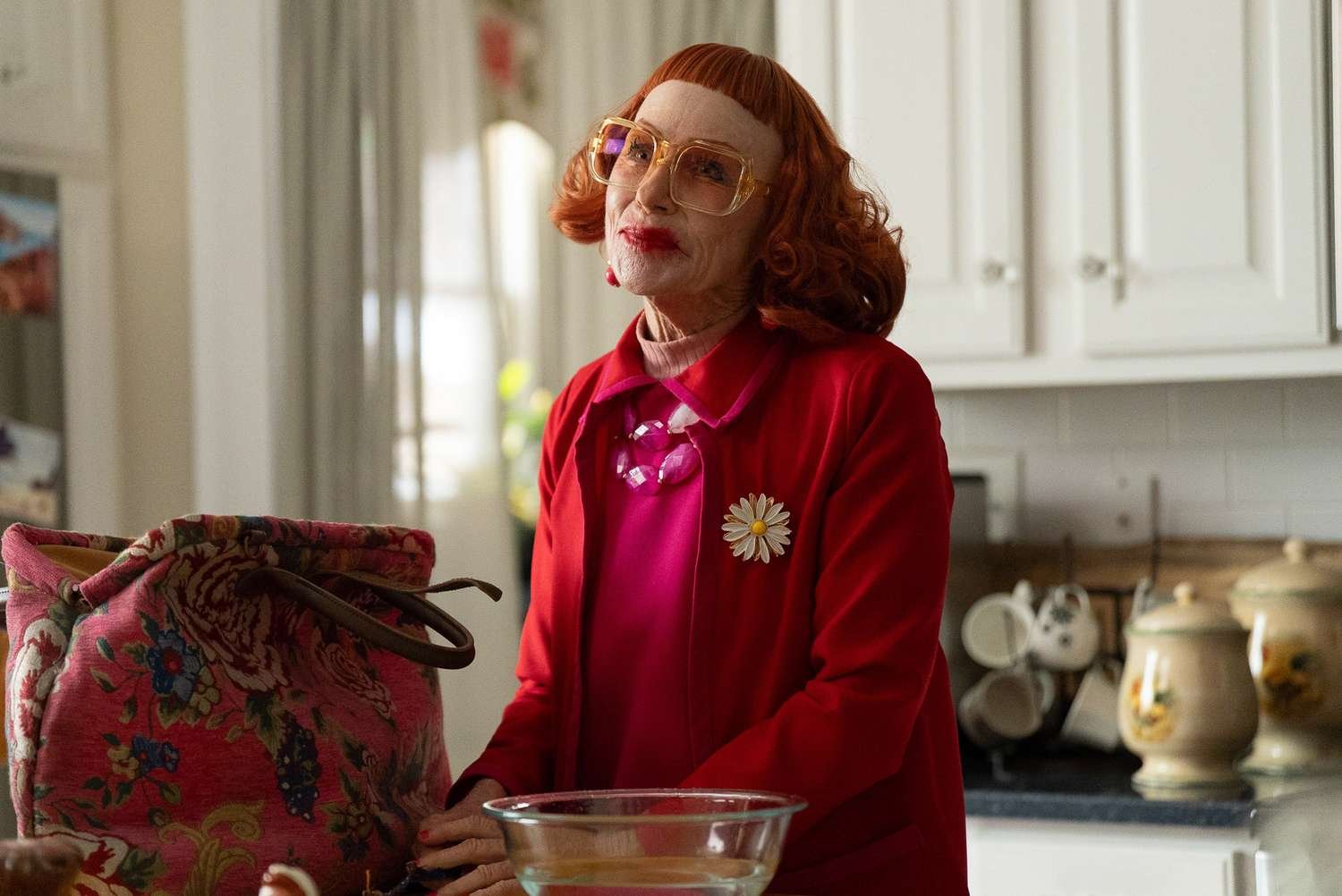
Comedy and horror are natural enemies. One wants the audience relaxed enough to laugh, the other needs them tense enough to flinch, and most films that try to hold both end up diluting each, landing somewhere in the mushy middle where neither the jokes nor the scares fully register. Weapons doesn't dilute anything. Cregger swings between a genuine punchline and a genuine gut-punch scene to scene, sometimes line to line, and the film never feels like it's hedging its bets between the two registers. It feels controlled, like a filmmaker who trusts that an audience can laugh in one breath and hold it in the next without the whole thing collapsing into tonal whiplash.
That control extends to structure. A film built around this many characters, each one carrying a piece of the same disappearance, risks becoming a collection of half-finished sketches wearing a trench coat labeled "ensemble drama." The temptation in this kind of multi-strand storytelling is to give the audience one character to actually care about and let the rest function as connective tissue. Cregger avoids that trap almost entirely. Every storyline gets enough space to land on its own terms, its own rhythm, its own stakes, and the film's confidence in cutting between them, rather than smoothing them into one continuous throughline, is what keeps the mystery feeling alive rather than mechanical. It would have been easy to let the structure become a gimmick, a way of withholding information for its own sake. Instead it circles the same dark center from different angles until the shape of it becomes unavoidable.
And then there's Gladys.
Amy Madigan's performance as Aunt Gladys is the film's center of gravity, the kind of turn that recalibrates everything around it the moment she's on screen. From her first scene she plays the character with a stillness that reads as warmth until it doesn't, and the shift never announces itself with a musical cue or a lighting change. It's in her face. That restraint is what makes her frightening. Madigan isn't performing menace, she's performing a woman who has stopped needing to hide anything, who has long since stopped seeing the people around her as anything other than useful, and the film is smart enough to let the audience catch up to that realization on their own.
It's a performance built to be talked about for a long time. The instinct to reach for Jack Nicholson in The Shining or Anthony Hopkins in The Silence of the Lambs isn't hyperbole here so much as the only available comparison class, actors who took a genre villain and turned it into something the culture couldn't stop quoting, referencing, imitating years after the fact. Gladys belongs in that conversation. She's not a twist or a reveal, she's a character who gets more unsettling the longer the film keeps her on screen, which is a much harder trick to pull off than the jump-scare version of horror villainy that leans on a mask or a monster design to do the work.
There's nothing hidden about her when she is on screen. Cregger doesn't need to keep her in constant view to keep her in control of the film, and that's arguably scarier, a villain who doesn't have to be present to still be running things.
What lingers after Weapons ends isn't the mechanics of its mystery, satisfying as they are, but the sense that Cregger built an entire ensemble piece as scaffolding for one performance to detonate inside of. That's not a knock on the rest of the cast, who earn their moments and carry the film's tonal high-wire act with real commitment. It's a testament to how completely Madigan takes over a film that was never short on ideas to begin with, and to how rare it is for a horror movie this stacked with talent to still feel like it belongs, unmistakably, to a single performance.
Rating: ★★★★ out of ★★★★★