
COTTON FEVER: A Crisis With a Human Face
Daniel Blake Schwartz's debut feature is the rare addiction drama that earns its anguish, and its grace.
By MIGUEL MATEO | JUNE 16, 2026
There is a particular kind of resignation that settles into you after years in Seattle. I lived there long enough to learn to walk past certain doorways without looking, to recalibrate the radius of my gaze on certain blocks, until the people hunched against the storefronts, the ones slumped in the shelter of a parking structure or a bus stop at midday, began to exist in a kind of peripheral fog. It's not cruelty exactly. It's the slow accumulation of exposure, the city's particular texture wearing something soft in you down to something harder. I've since moved on, but I carry that narrowing with me. I don't think I noticed when it happened. I just know that at some point, I had stopped seeing people.
Cotton Fever gave faces back to the people I had spent years learning not to look at.
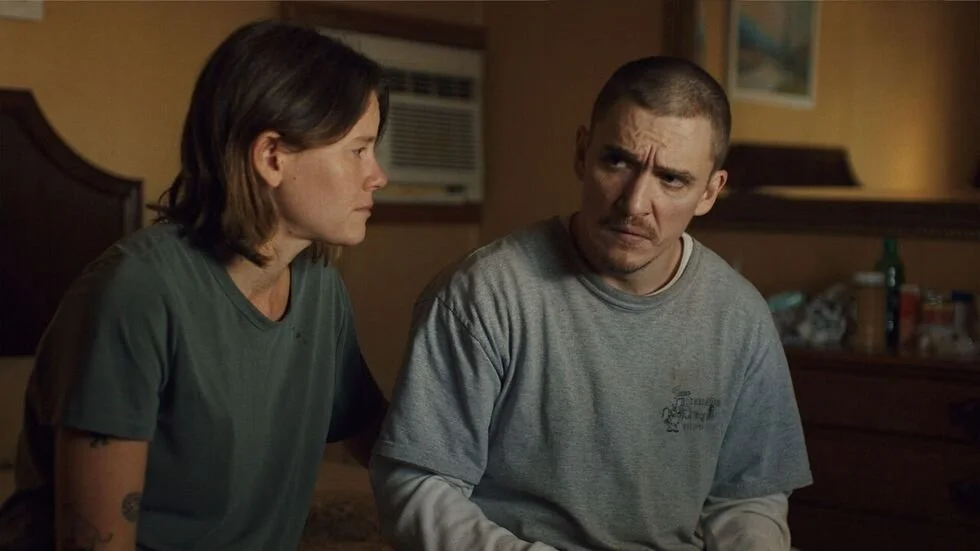
Writer-director Daniel Blake Schwartz, working from his own experiences with addiction, has set his debut feature on the streets of Chelsea, Massachusetts during the height of the fentanyl epidemic. The film follows a mosaic of interconnected lives: James (Kyle Gallner), a small-time dealer and addict who has recently relapsed; Dina (Sosie Bacon), his pregnant girlfriend fighting to hold onto her sobriety; Sam and Manny (Chabely Ponce and Ari Mora), a young couple living on the margins, surviving on settlement checks and bad luck; and Akil (Ronald Emile), a street outreach volunteer trying to save an addict city block at a time while watching his own brother disappear into it. These lives brush against each other without ever fully merging, which is precisely the point. Addiction isn't a shared journey. It's a series of solitudes.
What separates Cotton Fever from so many films that have attempted this territory is the perspective from which it operates. Schwartz isn't a filmmaker observing suffering from a careful distance. He's been inside it, and you feel that in every frame. Cinematographer Tom Acton Fitzgerald shoots with a restless intimacy, the camera moving with the characters rather than watching them, mimicking the particular anxiety of a life spent outrunning the next need. The performances match. Gallner, so often underused, delivers something genuinely raw here, and Bacon is his equal. But it's the ensemble in full that carries the film. Schwartz integrates non-professional actors into the fabric without a seam showing, and some of the film's most arresting moments belong to faces you won't recognize.
Crucially, the film resists the shape that most addiction narratives reach for. There's no spiral, no tidy third-act rupture where everything falls apart at once. Instead, Schwartz understands addiction as a pattern: a daily arithmetic of choices, of small self-betrayals, of moments where the door to something better is right there and a person walks past it anyway, not because they're weak or beyond saving but because the alternative is unclear and the pull is immediate. The film doesn't moralize. It doesn't need to. Schwartz has been too close to the material to be condescending about it, and that earned restraint is what allows the characters to breathe as actual people rather than object lessons.
The film occasionally loses momentum as it rotates between storylines, a byproduct of its mosaic structure, though one could argue that's integral to the design. These are lives that don't resolve neatly into each other. The film holds them alongside one another the way the street holds them alongside one another: in proximity but not in communion, occasionally reaching across and mostly missing. That is the texture of the crisis it's depicting, the one happening on corners I've long since learned not to look at too carefully.
The film closes on a note I won't detail here, but it lingers, one of the more earned and subtle expressions of hope I've encountered in recent cinema. Just a small, human moment allowed to sit in silence and mean what it means. For a film about people the world has mostly stopped looking at, that restraint is its own kind of argument. Cotton Fever is not a comfortable film, but it is a necessary one, and it reminded me that seeing, really seeing, is a choice you have to keep making.
Rating: ★★★★ out of ★★★★★
Screened at Tribeca Film Festival