
THAT FRIEND: RUNNING OUT THE CLOCK
Harvey Guillén carries this drug-fueled buddy comedy somewhere worth going, even when the road there feels well-traveled.
By MIGUEL MATEO | JUNE 19, 2026
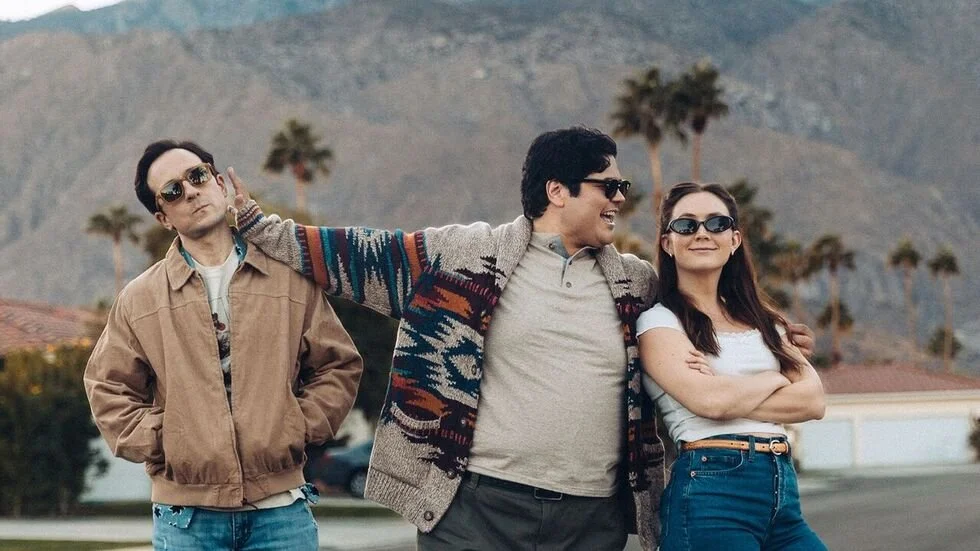
We all know someone like Paul. The friend who materializes at the worst possible moment, turns a quiet dinner into an event, and operates as though the world has agreed to stop aging right alongside him. Will Sterling and Alex Wall's debut feature leans into that archetype with genuine affection rather than contempt, and that distinction matters more than it might seem. When Paul (Harvey Guillén) crashes his best friend Henry's (Josh Brener) romantic weekend away with new girlfriend Penny (Billie Lourd), the film could easily tip into making him the villain of the piece. It doesn't, and that's where That Friend finds its soul.
The engine running underneath everything is a packet of drug-laced cigarettes that Paul loses track of, sending a rotating cast of strangers on unexpected trips. As a comedy of errors, That Friend operates in familiar territory. The mechanics of accidental drugging and escalating chaos have been rinsed through enough films by now that the individual set pieces don't always land with the impact they're reaching for. Sterling and Wall throw scenarios at the screen with enthusiasm, and some stick. But the film's real instincts lie less in the pratfalls and more in the pauses between them.
Those pauses belong to Guillén. Known largely from What We Do in the Shadows, he does something here that the film's premise doesn't obviously demand: he makes Paul moving. Paul is not just a hurricane of bad decisions. He's someone for whom time has kept moving despite every effort to convince himself otherwise, and Guillén holds that grief quietly inside a performance that could have been all surface. There's a moment late in the film where his affect shifts just slightly, and the whole thing reconfigures around him.
The film's central relationship is the friendship between Paul and Henry, and Sterling and Wall write it with the specificity of people who understand what years of history actually feels like. Henry finds Paul exhausting in the way you can only find someone exhausting when you've known them since before either of you became who you are now. Paul, for his part, loves Henry with the kind of uncomplicated devotion that Henry has long since moved past being able to return at the same frequency. That asymmetry is the film's quiet subject, running underneath all the noise.
Brener is well-cast as the wound-tight Henry, and Lourd makes Penny more than the new girlfriend who stands at the edges of someone else's history. The supporting ensemble earns its keep too: Retta appears as a welcome surprise, and Miles Gutierrez-Riley gets some of the film's most reliable laughs. The whole thing has the looseness of a production made by people who actually like each other, which is disarming in ways that more polished films sometimes can't manage.
That Friend doesn't entirely transcend the conventions of its genre. Some of the drug-comedy beats arrive from a familiar script, and the film is funnier in spirit than it is in specific laughs. But what Sterling and Wall have made is warmer than its premise suggests, and anchored by a performance from Guillén I didn't see coming. The film understands something true about what it costs to be the person still standing at the party when everyone else has already gone home.
Rating: ★★★ out of ★★★★★
Screened at Tribeca Film Festival