
Train Dreams Finds the Universe in One Ordinary Life
Clint Bentley's Denis Johnson adaptation finds the sublime in an unremarkable life, anchored by one of Joel Edgerton's finest performances.
By MIGUEL MATEO | NOVEMBER 7, 2025
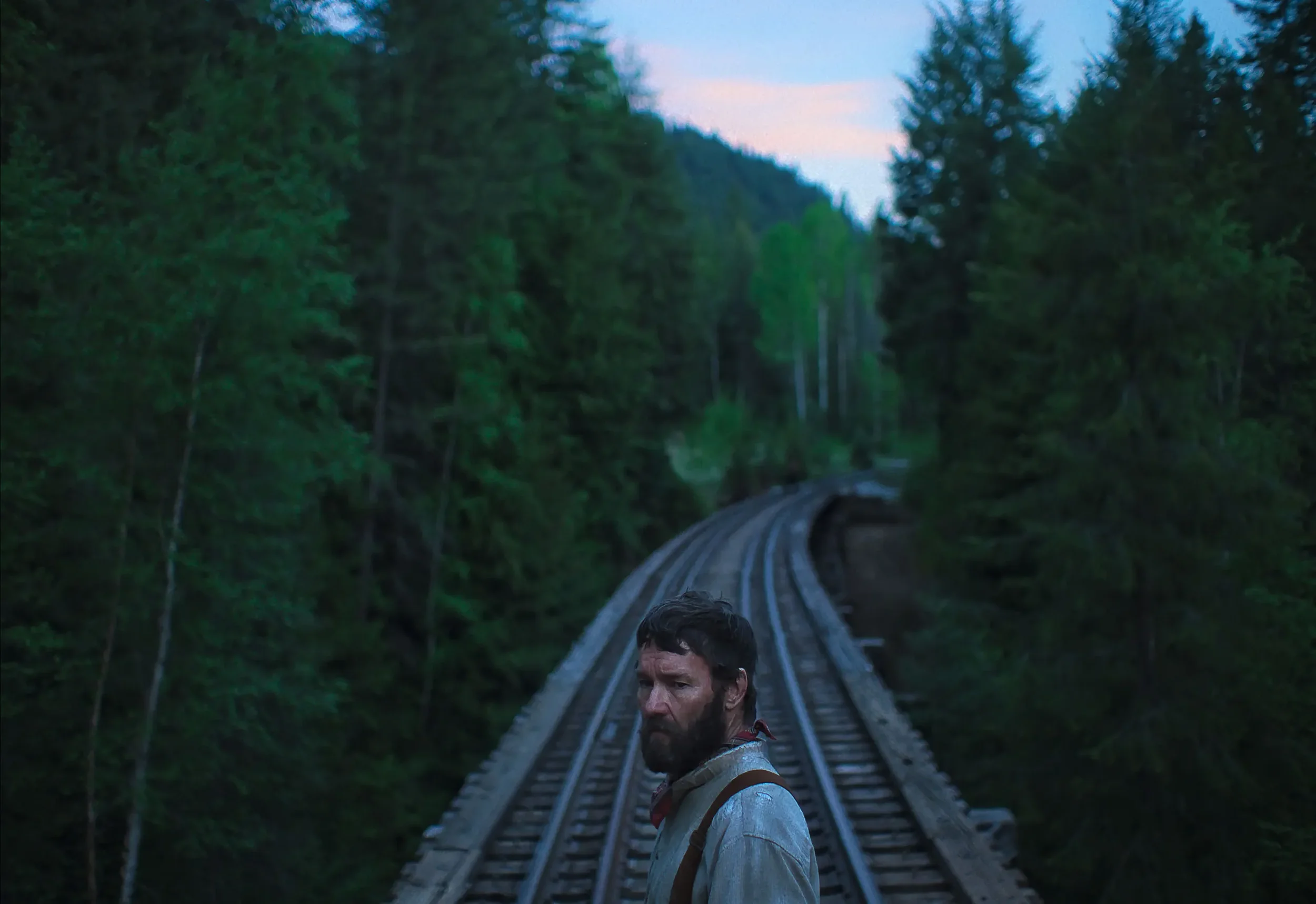
Clint Bentley's adaptation opens with a proposition that could easily curdle into sentimentality, that a life lived quietly, watched closely enough, discloses itself as vast. What keeps the film from tipping into that sweetness is patience. It never announces the size of what it's doing. It waits for the size to become obvious on its own terms.
Joel Edgerton plays Robert Grainier, an itinerant logger and railroad worker in the early twentieth century Pacific Northwest, and the performance moves like weather, arriving gradually, settling into the frame instead of announcing itself. Grainier does not narrate his own feelings, so the film finds them in his hands, in the set of his jaw around Felicity Jones's Gladys, in the way his silence thickens the moment loss enters a room. Edgerton has built a career on restraint, but here restraint becomes something closer to devotion, a man holding himself together so carefully that the seams show only in flashes.
Jones gives Gladys a whole interior life within a small number of scenes. She and Grainier build their cabin along the river with the specific, modest hope of every frontier marriage, a farm, a mill, a family close enough to touch every night instead of every season. The film lets that hope breathe before it takes it away.
The scene that crystallizes the film's whole philosophy is small enough to almost miss. William H. Macy's character looks out at the land and tells Grainier, "Beautiful, ain't it? Every bit of it." Delivered almost as an aside, the line becomes the film's compass. Bentley refuses to ration beauty out to the events that traditionally earn it on screen, the weddings, the reunions, the triumphs. He folds the felled trees and the flooded rivers and the years of unremarked labor into that same reverence, so a life spent mostly in silence still reads, in the end, as a form of grace.
That reverence is tested by fire. Grainier returns from a season of work to find his valley burned to ash, his wife and daughter gone without a body to bury or a moment to mark. He waits under the open sky for nights that do not end in an answer, and when his friend Ignatius Jack finally coaxes him back into the world, Grainier does the only thing his hands know how to do. He rebuilds the cabin on the exact plot of scorched earth where the first one stood. The film never explains this as denial or acceptance, letting both live in the same gesture, a man building a home for people he knows are not coming back, because building is how he loves.
Bryce Dessner's score moves through the film the way weather moves through the valley, present without insisting on itself, swelling only when the images have already earned the swell. Adolpho Veloso's cinematography treats the Pacific Northwest less as backdrop than as a character with its own long memory of everyone who has passed through it and left almost nothing behind. Watching the seasons turn over Grainier's cabin, the audience absorbs decades the way he does, not as a sequence of events but as a texture that thickens with time.
Some viewers have bristled at Will Patton's narration, treating it as a crutch the film doesn't need. It plays instead like memory speaking for itself, a voice arriving from just outside the frame the way a story gets told again once its subject can no longer tell it. It does not work against the film's trust in implication, it deepens it, giving Grainier's silence a witness to carry what he never could say aloud. When that voice finally allows Grainier to feel, at last, connected to it all, the line lands as permission, the film's way of letting its quietest man have the one clear sentence of his life.
By the time an old Grainier looks up from a shop window at an astronaut circling the earth, and later lifts off himself in a borrowed biplane over the valley he spent his whole life inside, the film has earned its final, enormous gesture without ever raising its voice to make it. The astronaut is the century arriving to look back at him. The biplane is Grainier, for once, allowed to look back at everything he built and lost and built again.
What remains, finally, is a quiet argument about scale. A man who crosses paths with only a handful of people across one stretch of forest can still hold, inside that small radius, the full range of what a person is capable of feeling. Train Dreams never treats its own tenderness as an achievement. It simply looks, the way Grainier does, until looking becomes devotion, and devotion becomes the whole of a life.
Rating: ★★★★★ out of ★★★★★