
Forgiveness, Perception, and the Stories We Tell Ourselves
Relationships often reveal who we are when certainty disappears. The Drama explores that space where love and doubt collide, exposing the fears we rarely say out loud.
By MIGUEL MATEO | APRIL 2, 2026
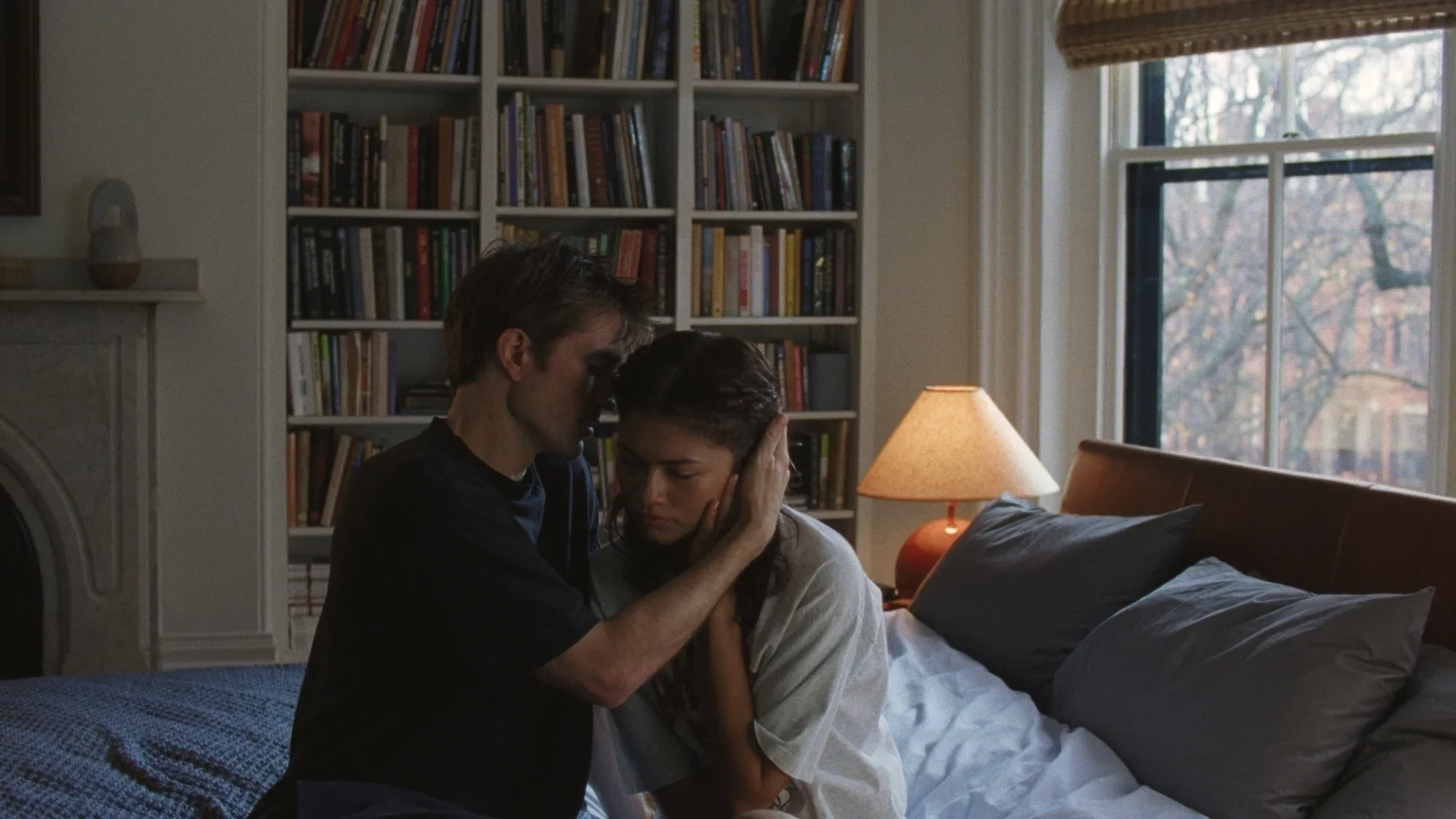
There are movies that provoke conversation, and then there are movies that stay with you long after the credits roll. The Drama falls into that second category.
It lingers in a way that feels almost unsettling. Scenes replay themselves hours later. The experience stays present because the emotional weight never fully settles. You leave the theater still thinking about the characters, still questioning how you reacted to what you saw, still turning over moments that felt simple at first and complicated the longer they sat with you.
That lingering tension is what makes The Drama feel so powerful and, in many ways, misunderstood.
Kristoffer Borgli introduces the story through a premise that feels deceptively straightforward. Emma, played by Zendaya, and Charlie, played by Robert Pattinson, are preparing for their wedding when a seemingly harmless conversation takes a darker turn. Each person shares the worst thing they have ever done. When Emma reveals a disturbing memory from her youth, the emotional foundation of their relationship begins to shift.
The revelation itself carries weight, yet the film draws its real strength from the reactions that follow. The people around Emma struggle to reconcile what they have learned with the person standing in front of them. Suspicion begins to grow. Doubt creeps into ordinary interactions. Every gesture becomes subject to interpretation.

At the center of the story sits a difficult question. Is a person defined by their actions, or by the thoughts they once carried?
Emma admits to planning something deeply unsettling in her youth. The act never happened, yet the knowledge alone reshapes how others view her. That distinction becomes the film’s emotional engine. The story unfolds through the reactions of others rather than the act itself.
As tension builds around her, Emma remains strikingly composed. Her calm feels intentional, as if she has spent years confronting this memory long before anyone else learned about it. She moves through conversations with steady confidence, rarely allowing her emotions to spill outward.
Still, beneath that steadiness, something begins to shift. A quiet form of paranoia develops as the story unfolds. She starts to sense that the person she trusted most to understand her may now be seeing her differently. That awareness lingers in small gestures and subtle pauses. Even moments of silence begin to carry weight. Her composure holds, yet the feeling of being redefined by someone else's perception becomes impossible to ignore.
That emotional tension feels deeply human. People rarely encounter uncomfortable truths without reshaping them in some way. Information becomes filtered through fear, imagination, and assumption. A single revelation can grow into something far larger once it passes through the lens of perception.

Zendaya carries the emotional weight of the film with remarkable control. Emma exists in contradiction. She needed to feel capable of imagining something frightening in her youth while still feeling recognizable and grounded in the present. That balance requires precision, and Zendaya delivers it through restraint rather than intensity.
Her performance thrives in small details. She listens carefully. She watches others before speaking. There are moments where she studies Charlie’s reactions, as if trying to anticipate the direction of his thoughts before he voices them. Those quiet observations create tension without relying on dramatic outbursts.
As the film progresses, her behavior begins to reflect that growing awareness. She adjusts the way she interacts with Charlie, subtly measuring each exchange. That quiet paranoia never dominates her performance, yet it shapes her presence in every scene. Trust begins to feel fragile, and she recognizes that fragility long before anyone speaks it aloud.
Robert Pattinson delivers a performance that complements this dynamic perfectly. Charlie becomes the emotional lens through which the audience experiences uncertainty. His reactions shift gradually, moving from curiosity to discomfort and eventually to fear. Each stage of that transition feels earned.
One moment captures this shift with striking clarity. Emma walks into the room holding a kitchen knife after preparing a smoothie. The action itself is harmless. Charlie’s reaction reveals how perception transforms ordinary gestures into sources of tension. His body language tightens, and his expression shifts almost imperceptibly. Fear becomes visible before he fully understands it himself.
That single moment captures the film’s central theme. Knowledge changes perception. Perception reshapes reality.
The emotional strength of the film grows from the audience’s ability to understand both characters at once. Emma’s composure feels genuine. Charlie’s fear feels equally believable. That dual empathy keeps the story grounded even as tension increases.
Tone plays a significant role in shaping the experience of the film, which moves between discomfort, humor, and psychological tension with surprising fluidity. Scenes that feel heavy often give way to moments of awkward humor. That rhythm mirrors the unpredictability of real emotional conflict.
Laughter appears in unexpected places, sometimes as a release from tension rather than a response to comedy. Those moments feel authentic because they reflect how people behave during stressful situations. Humor becomes a coping mechanism, surfacing when emotions feel too intense to carry alone.
The structure of the film reinforces this emotional instability through its use of flashbacks. These sequences function as psychological excavation rather than simple exposition. Memories appear in fragments, blending with present-day scenes in ways that blur the boundary between recollection and interpretation.
At times, Charlie imagines Emma’s younger self in ways that feel symbolic rather than literal. These moments illustrate what happens when new information forces someone to reinterpret another person’s entire history. The past becomes fluid, shaped by fear as much as fact.
That idea deepens the film’s exploration of memory. Recollection rarely remains objective. It shifts according to emotional context, bending to fit the expectations and anxieties of the present.

Supporting characters add texture to the film’s emotional environment. Caterers, DJs, photographers, and passing guests appear at moments when tension reaches its peak. Their presence introduces brief interruptions that reflect the unpredictability of wedding preparation.
That setting proves essential to the film’s effectiveness. Weddings carry their own emotional pressure. Expectations run high. Relationships become magnified under stress. By placing the central conflict within this environment, the film intensifies every reaction without needing exaggerated circumstances.
Music also serves an important narrative function throughout the film. A recurring song becomes tied to moments of reconciliation between Emma and Charlie. Each time it appears, it signals an attempt to restore balance. The repetition creates emotional association, turning a simple piece of music into a symbol of connection.
As the story unfolds, forgiveness emerges as the film’s central theme. The narrative asks whether people can move forward after learning something that alters their perception of someone they love. It raises questions about intention, accountability, and empathy.
Resolution arrives through reflection rather than spectacle. Emotional growth takes precedence over dramatic escalation. That choice reinforces the film’s focus on internal conflict rather than external chaos.
Some viewers may expect the tension to build toward explosive consequences. The film resists that expectation. Fear often expands through imagination, growing larger with each retelling. Characters project worst-case scenarios onto one another, creating narratives shaped by anxiety rather than reality.
That resistance strengthens the film’s message. Perception influences experience just as powerfully as truth itself.
Leaving The Drama feels less like stepping away from a finished story and more like stepping into an ongoing reflection. The film invites viewers to reconsider how they define morality, trust, and forgiveness.
Questions linger long after the final scene, while expressions remain vivid in memory. Moments that seemed simple in the theater grow more complicated with time.
That lingering presence speaks to the film’s emotional strength.
The Drama challenges its audience to sit with discomfort and uncertainty. It encourages contemplation rather than resolution. Stories that leave space for interpretation often create the strongest emotional impact.
This is the kind of film that rewards revisiting. Each viewing offers the chance to notice something new, to reconsider earlier reactions, to see familiar moments through a different emotional lens.
And that quality feels increasingly rare in modern filmmaking.
Rating: ★★★★ out of ★★★★★
Now streaming on Hulu and Hulu on Disney Plus